
Thanks to the internet and today’s social media landscape, information is everywhere; so much content and information at our fingertips, and it can be overwhelming to absorb in today’s online, connected world. With this kind of overload, it can be easy to fall into the trap of “fake news”. False information – whether intentional or accidental – can spread fast and may carry serious consequences.
Now more than ever it is important to develop your digital media literacy skills by learning how to spot misinformation. ‘Fact-checking’ is the process of verifying claims and information to ensure it is accurate and is a key skill to have when navigating not only the internet, but real-life as well.
What Is ‘Fake News’?
In plain terms, it’s a piece of information or media that is incorrect, misleading or heavily saturated by opinions instead of facts. There can be multiple signs of a news story being fake; it can’t be found in other news sources, it comes from fake sites or dodgy outlets, it doesn’t cite link or site its sources, and it plays on your emotions more than it should.
Why Should You Care?
- You deserve the truth – everyone has an opinion and the ability to make up their own mind, but you should have the facts to do so.
- It can hurt you, and/or a lot of other people – some misleading or fake news sources may help spread medical myths or make false claims to stir up the public. Some of the lies contained on these sites are dangerous.
- It can affect your credibility – if you share or spread content that contains misinformation, others may find it difficult to believe you in future – even if what you share later is factual
- Being informed benefits you – whether it’s voting in an election, making an investment or purchase, booking travel plans or even generally browsing online, you want to ensure you are reading accurate and factual information to make the best decisions.
How Can You Spot Fake News?
Here are some ways you can keep yourself informed and identify when fake news is present:
Be skeptical
Verify before you post (share, comment on, or interact with anything really). It’s good to listen to gut instincts too; if something looks or feels unbelievable, it may very well be the case.
Check your feelings
This may sound like a weird point, but many online algorithms are designed to draw strong reactions on purpose. Certain forms of information sharing are driven by engagement fueled by fear, anxiety, and rage – when you are able to take a step back, check your feelings and separate your emotions from the content, it can help you think critically and make better judgements, saving you from sharing something on impulse.
Use credible and reliable sources
These are primary, trusted sources such as news organisations, government websites, and academic institutions like universities. Places like these have processes to fact-check their own research and work and are more likely to be reporting the facts.
Check multiple sources
Always look in more than one place for your information. That way, you can get multiple perspectives and get the clearest picture of a situation.
Look for references
If a piece of text or a video links to sources they used, it can better support the claims being made. Links to studies, factual data and government resources can give your news media more credibility and establish provenance. In fact, going to the original source can be more beneficial in a lot of cases.
Don’t rely on social media platforms
Take information you see on social media with a grain of salt. Platforms such as Facebook and Twitter can be filled with misleading headlines, memes, and opinions that are strongly biased or completely untrue. Bots are also dominant on these platforms and are designed to spread discourse and misinformation.
Other mediums can also be fact-checked
Images and videos can also tell an unfiltered truth. Visual media can be edited or processed, but some can be more digitally manipulated or misused. One trick that sometimes occurs in fake news is when an article uses a real image from an unrelated event to try and prove their cause. You can use Google and sites like TinEye to do a reverse image search, which can help find the source of an image.
Use fact-checking tools and platforms
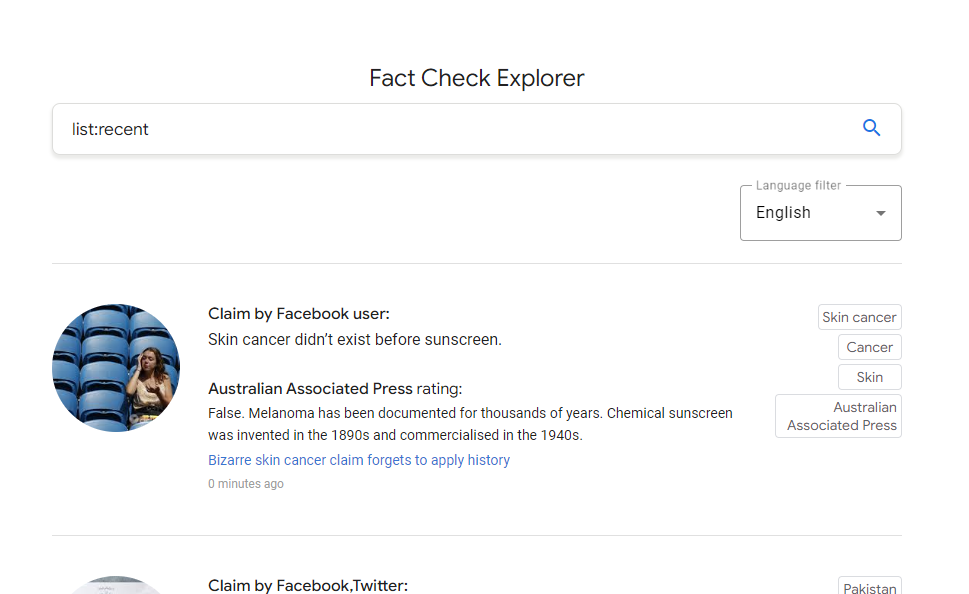
Many tools and resources now exist to help fact-check information online. Different browser extensions and pages such as Google Fact Check Explorer, PolitiFact.com, Snopes.com or The Wayback Machine can help you verify information as you use the internet. Simply opening up an extra browser tab to fact-check can do wonders – here’s an example from Google Fact Check Explorer of a disproven false claim at the time of writing this blog.
Don’t take mistakes to heart
If you happen to miss something or fall for a fake article, take it as a learning opportunity. Even the best researchers get it wrong sometimes!
There are many other things you can look for when learning to identify false information. In keeping in spirit with this article, I have linked my sources below for many of these tips (and more that weren’t covered here!) as well as the Google Fact Check Explorer tool:
Fact Check Explorer (google.com)
The News Literacy Project Classroom Guide (ben.edu)
These 6 tips will help you spot misinformation online – Poynter
How to Fact-check: 5 effective ways – Fact Protocol
Nexis-webinar-how-to-fact-check-like-a-pro.pdf (lexisnexis.com)